An elevator emergency phone is the two-way communication device inside a lift car that connects a trapped passenger to someone who can send help. It is not optional equipment. ASME A17.1 requires a communications means in every passenger elevator, and the edition your building is held to depends entirely on where you are.
45 s
Before an unanswered call must route to an alternate location
60 ft
Rise at which an in-building means for emergency personnel is required
4 h
Minimum backup power for the communications means
1 h
Minimum backup power for the audible signaling device
What the code actually requires
The clauses below are from ASME A17.1, 2019 and 2022 editions. Clause lettering is edition specific, so the edition always has to be named. Adoption is not uniform. States adopt different editions and amend them, so treat this as the shape of the requirement and check what your jurisdiction actually adopted.
| Clause | What it requires |
|---|
| 2.27.1.1.1 | A communications means between the car and a location staffed by authorized personnel who can take appropriate action. |
| 2.27.1.1.2 | If the call is not acknowledged within 45 seconds, it must be automatically directed to an alternate on-site or off-site location. |
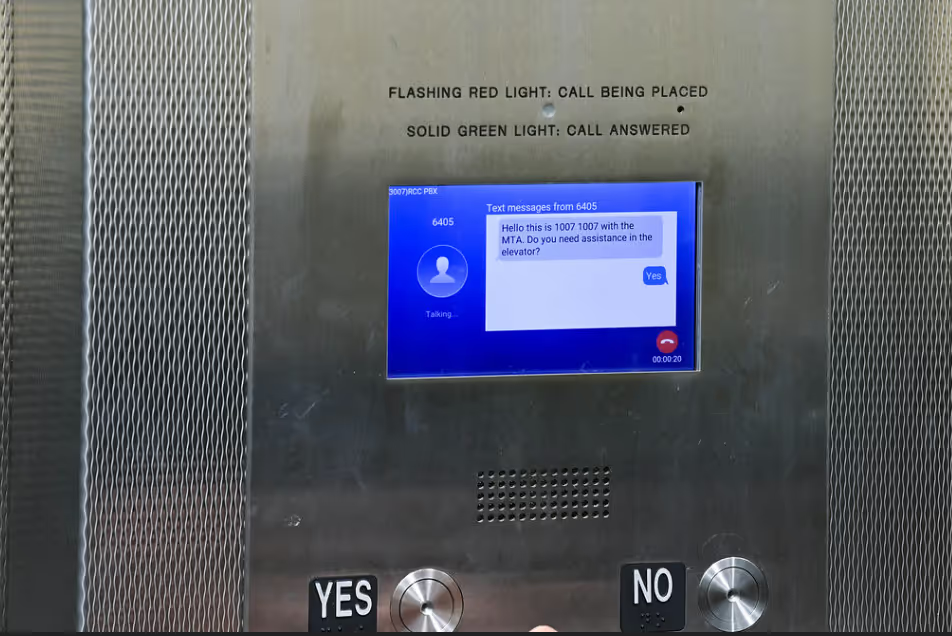
| 2.27.1.1.3 | The device in the car. A displayed message confirming communication is established, messages that let authorized personnel communicate with and get responses from a passenger who cannot speak or hear, a message indicating help is on the way, and a means to display video of the car floor for entrapment assessment. |
| 2.27.1.1.4 | Where rise is 18 m (60 ft) or more, a communications means inside the building that emergency personnel can use to reach each car. |
| 2.27.1.1.5 | Backup power for at least 4 hours for the communications means and 1 hour for the audible signaling device. |
The video requirement on the in-car device has no rise threshold. Several well known industry sources say video applies only above 60 feet. That conflates the in-car item with the separate emergency personnel item, and it is wrong.
If your building is in New York City, you are not on A17.1-2019
New York City Building Code 2022, Appendix K, Chapter K1 is titled Modifications to ASME A17.1-2013. Not 2019. NYC runs its own modified version, and that modified version is the adopted law an inspector enforces.
NYC also adds requirements the national text does not contain. Two-way voice communication between the car and the machine room or control room. An in-building means for emergency personnel located at the designated level, and inside the fire command center where one exists. And where that means sits behind a locked panel, it has to open with the New York City Fire Department standard and New York City standard keys.
New York State outside the city is in transition. The 2020 Building Code of New York State references A17.1-2016, which carries no video requirement. The 2025 edition references A17.1-2022, which does. For an upstate building the honest answer depends on your permit date.
If a vendor quotes you A17.1-2019 for a New York City job, they are citing the wrong document. We keep a state by state reference here.
Who has to answer the call
There is no clause in A17.1 that uses the words central station, monitoring station, third party, in-house or outsourced. The code is performance based. It says the call must reach a location staffed by authorized personnel who can take appropriate action, and it leaves the identity of those people open.
So two claims you will hear are both wrong. Anyone telling you the code requires a central station is selling, not citing. And anyone telling you monitoring is optional is also wrong, because the obligation itself is absolute.
What is genuinely ruled out is pointing the elevator phone at a number tied to the building owner or manager and calling it done. The Wisconsin Department of Safety and Professional Services put it plainly in its 2023 guidance: calls may not go only to an individual or telephone number affiliated with the owner. Buildings with trained staff on duty can answer in-house. Buildings without 24-hour staffing send calls off-site, commonly to an answering service, a security company or the elevator company.
One more distinction worth having, because it gets argued. The code prohibits the call being answered by an automated answering system. It does not prohibit automated routing. The ASME A17 Standards Committee addressed this directly in Inquiry 13-1022, approved 11 September 2013: voicemail and answering machines are prohibited, a PBX routing the call to the next available authorized person is not.
None of this is retroactive
These requirements apply to new installations and to alterations that trigger the alteration provisions. They are not retroactive to elevators already in service. An existing communication device can generally stay until it fails. Anyone implying that every building in the country now needs video is overstating it.
What these devices get called
The same equipment goes by a lot of names depending on who is writing the spec, so it is worth putting them in one place.
- Elevator phone or lift phone. The device in the car itself.
- Elevator call box or elevator emergency call button. Usually the same device, named for the button rather than the handset. Modern units are hands-free with no handset at all.
- Elevator cellular communicator. A unit that carries the call over a cellular network instead of a copper line, used where a building has no usable landline. Whether that satisfies your inspector depends on the adopted edition and local amendments.
- Elevator intercom or lift intercom. Often used for landing and lobby stations that talk to the car, not the code-required emergency line.
- Firefighter phone. Informal name for the in-building means at 60 ft and above. It exists so responders already in the building can reach each car and take over the line. It is not a monitoring point and it does not answer routine entrapment calls.
By building type
What the code says is the same everywhere. What it takes to actually deliver it differs a lot by building, so we have written these up separately.
- Transit and rail. Deep stations, distributed sites, work that has to happen around service.
- Hospitals and healthcare. Segmented networks, mixed elevator generations, and a riding public that includes people who cannot use a voice phone.
- Government and municipal. On-premises requirements that come out of security review rather than preference.
- Airports. Operations that never stop and a security operations centre already watching everything else.
- Schools and universities. Modernization budgets, summer install windows, and IT teams that do not want cloud devices on the school network.
- Hotels and hospitality. A 24/7 front desk that can serve as the answering point, which removes the recurring monitoring cost.
- Public housing authorities. Portfolio scale, procurement rules and long service life.
Not sure which edition your building is held to?
That is usually the first thing worth settling, and it is not always what the last vendor told you. Book a call and we will work out what your jurisdiction actually adopted, what your elevators need, and what can wait.
Book a call